Welcome!

This blog provides commentary on interesting geological events occurring around the world in the context of my own work. This work is, broadly, geological fluid dynamics. The events that I highlight here are those that resonate with my professional life and ideas, and my goal is to interpret them in the context of ideas I've developed in my research. The blog does not represent any particular research agenda. It is written on a personal basis and does not seek to represent the University of Illinois, where I am a professor of geology and physics. Enjoy Geology in Motion! I would be glad to be alerted to geologic events of interest to post here! I hope that this blog can provide current event materials that will make geology come alive.

Banner image is by Ludie Cochrane..

Susan Kieffer can be contacted at s1kieffer at gmail.com


Showing posts with label aurora. Show all posts

Saturday, January 21, 2012

Solar "Blob" of Plasma Headed our Way

The Sun on January 21, 2012
Sunspot 1401 erupted on January 19
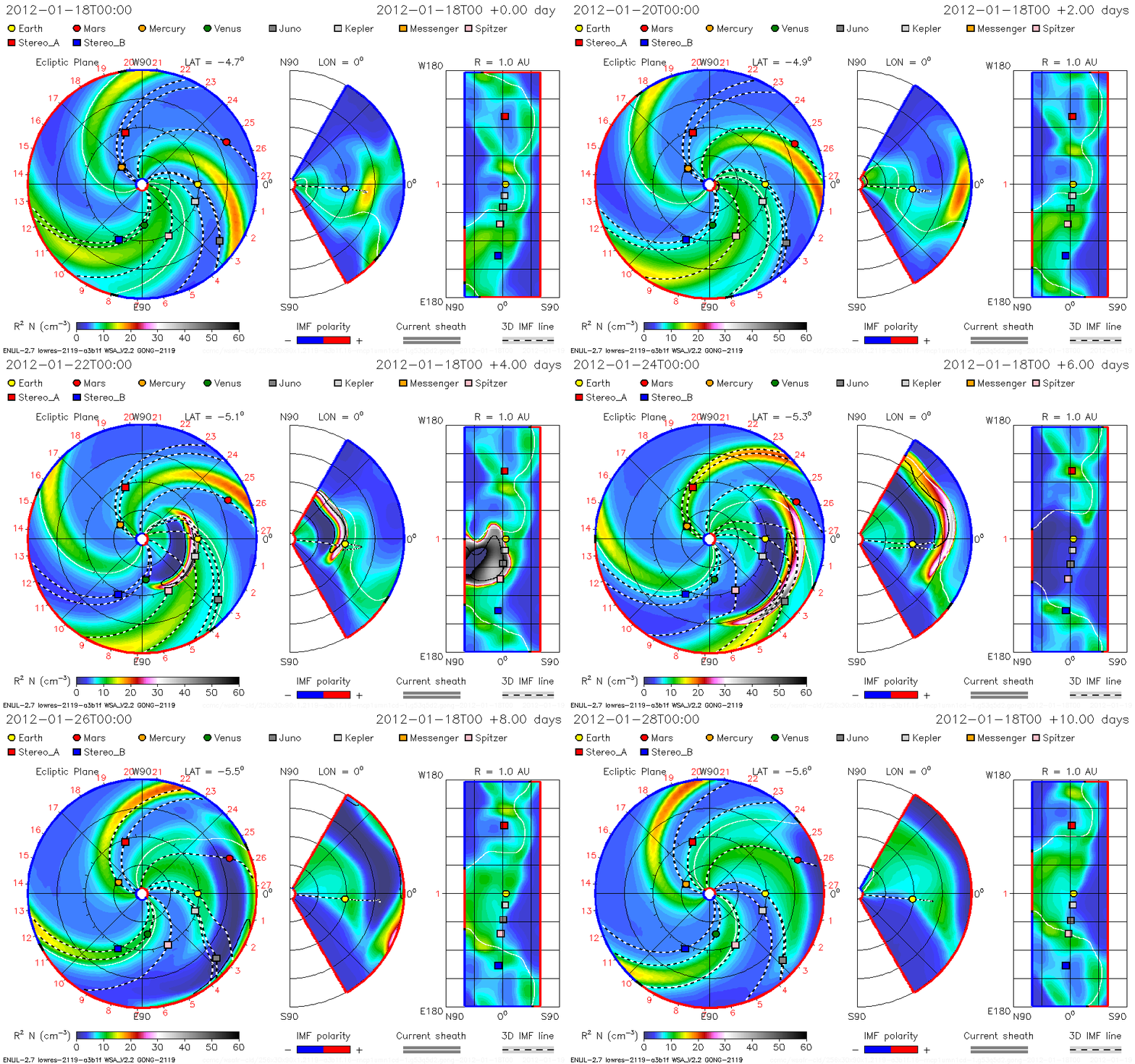
According to Spaceweather.com, sunspot #1401 erupted on Friday around 16:30 UT producing a solar flare and coronal mass ejection (CME). The cloud is heading toward the earth. A

Here is a neat animation of the forecast, showing not only the Earth, but Mars, Mercury and Venus as well as a few spacecraft in orbit. The cloud is expected to hit here on Saturday, around 22:30 UT (plus or minus 7 hours). (The Space Weather Prediction Center has forecast that it will hit at high northern latitudes around 1:00 p.m. EST on Sunday, with the bulk of the disturbance on Monday.) Initially there were apparently fears that this would be a direct blast that could seriously threaten communications and satellites, but the Post reports that it is more likely going to be a glancing blow affecting high latitudes. It will reach Mars on January 24th.

We are heading toward a sunspot maximum in 2013, and sunspot activity and flares like this may increase. Another consequence of increasing sunspot activity is that the UV radiation levels increase from the sunspots. This activity "puffs up" the earth's atmosphere which puts drag on low-altitude space debris, causing it to slow down and eventually fall out of orbit.  Space debris has become a major concern for safety of the astronauts in orbit, and getting rid of some of it in this way is a good thing. I hadn't been aware, but in 2007 the Chinese "killed" one of their weather satellites in a test, creating over 3,000 pieces of debris bigger than golf-ball size. Only 6% of this debris has re-entered the earth's atmosphere.  There was also a collision of Cosmos 2251 and Iridium 33 satellites that created debris.

Could be some good aurora somewhere!

Here's more on CME's and sunspots from earlier posts: (1) The 1859 Solar Superstorm; (2) Solar Activity (and Newt Gingrich)--well, that's relevant today since it's the South Carolina Republican primary vote!!)

Tuesday, December 14, 2010

1859 Solar Superstorm

"The Northern Lights"
Frederick Church, American painter
painted in the 1960's,
perhaps inspired by the 1859 superstorm
I had an earlier post on a the current solar activity in the context of a concern of Newt Gingrich who has made it a political issue. NASA has an interesting blurb today that lays out some of the concerns, and this blog is a summary of that article which puts "The Great Solar Superstorm of 1859" in perspective of the events of the last half of the 20th century.  It includes the following collage of events from past descriptions of superstorms:

"She ran screaming down the street, unable to contain her terror as night was turned into hideous crimson daylight…communications networks failed and equipment burst into flame…a bustling city lost power, trapping thousands of people inside elevators…satellites malfunctioned and in an instant millions of people lost touch with critical services, doctors and children."


From the NASA report cited. Based
on the work of Smart et al.
The 1859 superstorm lasted for 10 days, and is deemed one of the most spectacular solar storms in the past 450 years.  The basis for saying this comes from work by Michael Smart and colleagues who discovered that nitrate concentrations in trapped gases in the Greenland and Antarctic ice crystals rise and fall with solar activity. The graph to the right shows atmospheric nitrate (NOx) abundances from Galileo's time to the present, with the 1859 event highlighted in red.  The article calls attention to the time period during which the satellite industry has based their estimates of "worst case" scenarios: the last part of the 20th century in which there were only two major events, August 4, 1972 and March 1991.  In contrast, since 1561, there have been 19 events more intense than these two, with an average (though nonuniform) interval of 23 years. "The current 40-7ear-0eriod has been the least productive in generating large [events] as far back as 1670 during the Maunder Minimum.  If you wanted to build satellites that endure the rigors of the space environment, Cycle 23 [our last one] and some of the severe storms during the last 50 years, were probably the wrong examples to use as a 'tall pole' for how bad things can get." (I need to update my NASA jargonese, never heard the 'tall pole' analogy before; wonder if goes with their newly discovered sense of drama (the collage above, and sunspot description mentioned below!).


Nevertheless, during Cycle 23, there were satellite outages and losses totaling nearly $3 billion, and commercial satellites collectively lost about 3 years of lifespan at an estimated eventual cost of tens of billions in lost profit.  There were also several near-misses with US electrical grid blackouts.  Those in Quebec who remember the day that the power grid went down in March in Quebec, or those of us who are here in a deep freeze in the midwest this December shudder (literally) at the thought of a length power outage.


If Cycle 24 (the one we have now begun) were to have such a storm, it would be close to sunspot maximum, sometime between 2010 and 2012, likely in March or September during the Equinoxes. If astronomers notice a "large, angry-looking" sunspot (when did NASA start writing poetically?!!) crossing the solar meridian, time to look out.  It is predicted that all satellites on the daylight side of Earth would be blacked out by an intense blast of X-rays and energetic particles.  The X-rays would destroy the D-layer and cause shortwave blackouts; ozone would be depleted by 5-10% causing a spike in skin cancer events.  Auroras would dazzle us around the world. Computer systems on earth would crash as the integrity of their binary information systems is compromised.  Satellite losses and malfunctions would run up to $20 billion losses, Defense Department satellites would be blinded in some ways, and GPS systems would report inaccurately. This would affect precision navigation, oil drilling, search and rescue, and military targeting. 150 million people in north America would suffer a blackout without any precedent. Components of transformers for which there are no replacements would be damaged and have to be manufactured overseas.  The daily cost could be $30 billion in lost salaries, spoiled food, and closures--a larger scale example of the danger of global interconnectedness that the Icelandic volcano Eyjafjallajokull showed us earlier this year.