Welcome!

This blog provides commentary on interesting geological events occurring around the world in the context of my own work. This work is, broadly, geological fluid dynamics. The events that I highlight here are those that resonate with my professional life and ideas, and my goal is to interpret them in the context of ideas I've developed in my research. The blog does not represent any particular research agenda. It is written on a personal basis and does not seek to represent the University of Illinois, where I am a professor of geology and physics. Enjoy Geology in Motion! I would be glad to be alerted to geologic events of interest to post here! I hope that this blog can provide current event materials that will make geology come alive.

Banner image is by Ludie Cochrane..

Susan Kieffer can be contacted at s1kieffer at gmail.com


Showing posts with label CME. Show all posts

Wednesday, September 10, 2014

Major solar storm, alert for a CME, coronal mass ejection

Sunspot region 2158, the source of a solar flare today
From Spaceweather.com here
UPDATE 2: From space watch.com:

STORM WARNING (UPDATED): Among space weather forecasters, confidence is building that Earth's magnetic field will receive a double-blow from a pair of CMEs on Sept. 12th. The two storm clouds were propelled in our direction by explosions in the magnetic canopy of sunspot AR2158 on Sept. 9th and 10th, respectively. Strong geomagnetic storms are possible on Sept. 12th and 13th as a result of the consecutive impacts. Sky watchers, even those at mid-latitudes, should be alert for auroras in the nights ahead.

UPDATE 1: I have posted a number of relevant items over the past few years on solar storm activity: 
While our daily earth-weather is filled with heat waves still hitting us as summer fades into autumn, something 'out there' is ready to hammer us! Sunspot region 2158 spat forth a "long duration X1.66 (R3-strong radio blackout) solar flare today. It peaked at 17:45 UTC on Sept. 11  (11:45 a.m. PST on Sept. 10).

This sunspot region has been active for a few months. On September 1 it was the source of a flare, but on the backside of the sun. However, this region is now directly facing the earth. Solar scientists are awaiting data, but they think that it's likely that a Coronal Mass Ejection (CME) of particles will follow.  Information is updated regularly at NOAA's Space Weather Prediction Center here.

Why should we care? A CME has the potential to disrupt electronics that we depend on, whether in space for communications or on earth in health care facilities, computer centers, or communications facilities. A CME can also pose biological risk to astronauts and to passengers and crew in high-altitudes--especially if they are flying cross-polar routes where the particles preferentially come into the earth along magnetic field lines.

According to Mike Wall, a senior writer at Space.com,  the sun "unleashed an X-class solar flare--the most powerful type" today, and it also fired off another intense flare yesterday. Fortunately, NASA in these times of diminishing funding, still has the Solar Dynamics Observatory spacecraft which recorded the event. The flare was an X1.6 storm, and space.com says that it "poses no danger to anyone on Earth or the astronauts living aboard the International Space Station." However, radio communications on earth, the side facing the sun could experience radio communications lasting 'more than an hour.' However, if the eruption is accompanied by a CME, in 2-3 days, there might be significant geomagnetic storms that can disrupt GPS signals, power grids, and  communications.

We are near the peak phase of the Sun's 11-year cycle (Solar Cycle 24), but this phase is the weakest in about 100 years....and that's a whole other discussion!

Tuesday, May 14, 2013

Space Weather and Us

NASA art rendering of the systems affected
by space weather: aircraft, satellites, astronauts,
and the earth
Source: NASA here gives "fun facts" about the sun

Let me preface this with a disclaimer: I took a graduate level course in "Electricity and Magnetism" from one of the most fearsome texts ever inflicted on a student, the infamous "Jackson's E and M." It's still used to this day, and everyone that I've met has agreed with me on the difficulty.***See footnote! I not only took it once (in the physics department at the University of Colorado) but again (in the physics department at Caltech) where I didn't understand it any better than the first time around.  I blame at least part of my difficulties on faculty who didn't tell me that a course in complex variables was a prerequisite--I'd never had it, and my knowledge of complex variables was limited to the square root of -1!..... Ah, it feels good to make that confession after a mere 45+ years! Hopefully this deficiency won't show up in this post!

Imagine being a telegraph operator and getting shocked by your equipment, or getting up because it was light out only to find out that it was still the middle of the night, or seeing aurorae in the Caribbean! These are some of the effects of the so-called "Carrington Event," a powerful geomagnetic storm in the earth's magnetosphere caused by a massive solar flare and a coronal mass ejection (CME). This was the largest on record, but there have been others. The scientist, Richard Carrington connected the earth's disturbance to the solar flares and is considered the father of "space weather."

A huge solar flare in 1989 shut down Hydro-Quebec, the power grid servicing all of Quebec (and if you've been in Quebec in the winter you can imagine the consequences of such a shutdown).  The storm caused tripped five lines from the James Bay facility, causing a loss of over 9,000 MW during a time when the integrated power system (that included Chrchill Falls and Mania-Outardes) was demanding 21,000 MW. The system couldn't withstand that loss and collapsed within seconds. It took 9 hours to restore service and even then 17% of Quebec customers were without electricity. Restoration occurred on a Monday morning when there is typically a high demand on the system, exacerbated by a high demand in heating after 9 hours without power. Another storm in August 1989 caused a halt to trading on Toronto's stock market. Fears today are that similar storms could cause severe damage to modern "smart power grids," perhaps knocking out power for months over areas of hundreds to thousands of miles wide. Financial services, clean water supplies, and even medical care could be crippled by such an event.

In addition to disturbances in the earth's magnetic field, some effects of space weather are high radiation levels, auroras, power outages, radio blackouts, satellite damage and space radiation hazard to astronaut health. In the April 30 Eos, Transactions of the American Geophysical Union, Madhuilika Guhathakurta at NASA headquarters updates NASA space weather research. NASA needs to know the "weather" everywhere in the solar system because there are satellites currently out to the far outer reaches, and it's only a matter of time before astronauts are there as well.

Only a year ago, an intense event occurred, covered on my March 7, 2012 post (Apologies to the reader, but for some reason Blogger is not doing links properly these days). Earlier ones that I have posted including the "Newt Gingrich headliner" of November 14, 2010 that got a lot of hits when I posted it! There is a nice movie on that post. Also, see  January 21, 2012, for January 23, 2012, and March 7, 2012. The last one lasted two weeks during which an "angry-looking active region rotated across the solar disk and fired off more than 50 flares, 3 of which were X-class flares, the most powerful type of flare." Before it died, it had hit every spacecraft and planet in the solar system at least once with either a CME or a burst of radiation. The Eos article reports a private communication that this massive activity caused reboots and data outages on as many as 15 NASA spacecraft.

The Eos article is entitled "Interplanetary Space Weather: A New Paradigm." The "new paradigm" is that in contrast to the 'older days' when the focus was on forecasting space weather in the vicinity of the earth, it can now be forecast throughout the solar system, and it was this capability that allowed some protection for spacecraft during the 2012 outburst. NASA has a "heliophysics" fleet of spacecraft, and now has been joined by the Japanese Aerospace Elploration Agency, the European Space Agency and NOAA. Using techniques akin to those used for hurricane forecasting tracks, massive supercomputers at NASA Goddard combine satellite and ground-based data to predict when storms will hit the planets and the NASA spacecraft. E-mails are sent to alert mission scientists when a bout of space weather is about to hit them.

Two types of magnetic field lines, closed
lines (closed loops, A) and open lines
(the unipolar magnetic field B)
This image is from the Wiki article here.
It is actually for the sun, but imagine that
A is centered over a magnetic
center in the crust of Mars, as is B
but for B the solar wind is sweeping
the lines far out into space.
One of the more interesting and speculative comments in the Eos article relates to the difference in solar wind interactions with Mars and earth. Citing an article by Brain*, Guhathakurta notes that the magnetic field of Mars is much more complicated than that of the earth. Strong crustal magnetic fields around the planet interact directly with the solar wind. The crustal fields are strongest in the old, heavily cratered, southern hemisphere, except in the large impact basins, such as Hellas and Argyre, which have basically no fields. Crustal fields can be detected as far as 1000 km above the surface, which has implications for the Mars-solar wind interaction. (Added to these effects is the rotation of Mars that changes the orientation of the crustal fields with respect to the solar winds over time.)

The existence of crustal sources of magnetism on Mars means that the magnetic fields are very complicated. Brain describes thee different topologies that the field lines can take on: ones with both "ends" in the interplanetary magnetic field (IMF), closed field lines connected at both ends to Mars (the so-called crustal field lines), unconnected field lines connected at both ends to the IMF, and ones that are open and connect Mars to the IMF. Changes in topology amongst these lines by reconnecting or merging allow the solar wind plasma to be trapped in so-called "magnetic field umbrellas".  This leads to a possible answer to a long-standing question: Why doesn't Mars have an atmosphere? We know that Mars once had an atmosphere thick enough to allow liquid water to exist on the surface, yet now it's atmosphere is only a few millibars, a few thousandths of that of the earth. Is it possible that magnetic umbrellas were involved? Could solar wind buffeting the umbrellas cause the magnetic field to pinch off parcels of air trapped in the umbrellas and propel air-filled magnetic bubbles into space?
     In 1992 Janet Luhmann and colleagues noted, from Pioneer Venus observations that the atmosphere of Venus was being stripped by the solar wind. They predicted that a substantial loss would have occurred in Martian history. Bruce Jakosky used the ratio of 38Ar/36Ar in the atmosphere and in martian meteorites, and noted that it was some 30% greater than that of the Earth and loss to space was the only process that could produce this type of enrichment in a noble gas. These studies, along with those of other isotopes, suggest that 50-50% of the atmosphere has been lost over time. These studies, amongst others, lead to NASA's MAVEN mission to Mars, set to launch in about 6 months. One goal of MAVEN is to relate the upper atmosphere/solar-wind interactions to the climate and atmospheric history to unravel the history of the surface and past or present habitability by microbes.

Wow...sure makes me wish that I'd done better in that E and M course!

*Brain, D.A., Mars Global Surveyor Measurements of the Martian Solar Wind Interaction, Space Science Reviews, 126, 77-112, 2006.
***See the hilarious comments about this book here (second edition, the red book) and here (third edition, the blue book)! We true veterans have the green book, 1st edition!

Tuesday, January 24, 2012

Go Sun!! Biggest Solar Flare since 2005!

Evolution of the January 23, 2012 solar flare. Images, from left to right,
taken at 3:27, 3:42, and 4:13 UT. NASA Solar Dynamics Observatory
After a solar minimum that was unusually quiet and prolonged, the Sun has reawakened. Following the January 21 flare (previous post), the biggest outburst since 2005 occurred late on Sunday night, January 22, 2012, around 11:00 p.m. EST, sending a shower of charged protons toward the earth. (The flare was assigned a M8.7 intensity, and is expected to hit the earth today at 9 AM ET (plus or minus 7 hours). Here's the NASA release.

What is the difference between a solar flare and a coronal mass ejection? A solar flare is an intense burst of radiation from a sunspot as magnetic energy is released in an explosive event. It releases light at almost every wavelength of the spectrum.  A coronal mass ejection is mass released during a flare, primarily gas, often billions of tons.  CME's are sometimes associated with flares, but can also occur independently of a flare.

How are solar flares classified?
Solar flares are classified on a logarithmic scale (similar to the Richter magnitude scale), with each class having a peak flux ten times greater than the preceding one.  The flux is measured in watts per square meter (W/m**2) in a particular wavelength range (100-800 picometer X-rays) near the Earth, as measured by GEOS spacecraft. Within each class there are 9 sub-categories, each being twice as big as the previous one.  The classes are, in increasing order, A,B,C,M, and X. The flare discussed here was rated as a M8.7, just slightly below the most intense X category.

How is the effect of a flare on the earth classified?
A solar flare and CME can cause a geomagnetic storm on the earth, a disruption of our magnetosphere.
Here's a link to the classification of the effects of geomagnetic storms on earth.

Here's a link to a longer explanation.

Here, here, and here are previous posts on this blog that might be of interest.

Saturday, January 21, 2012

Solar "Blob" of Plasma Headed our Way

The Sun on January 21, 2012
Sunspot 1401 erupted on January 19
According to Spaceweather.com, sunspot #1401 erupted on Friday around 16:30 UT producing a solar flare and coronal mass ejection (CME). The cloud is heading toward the earth. A

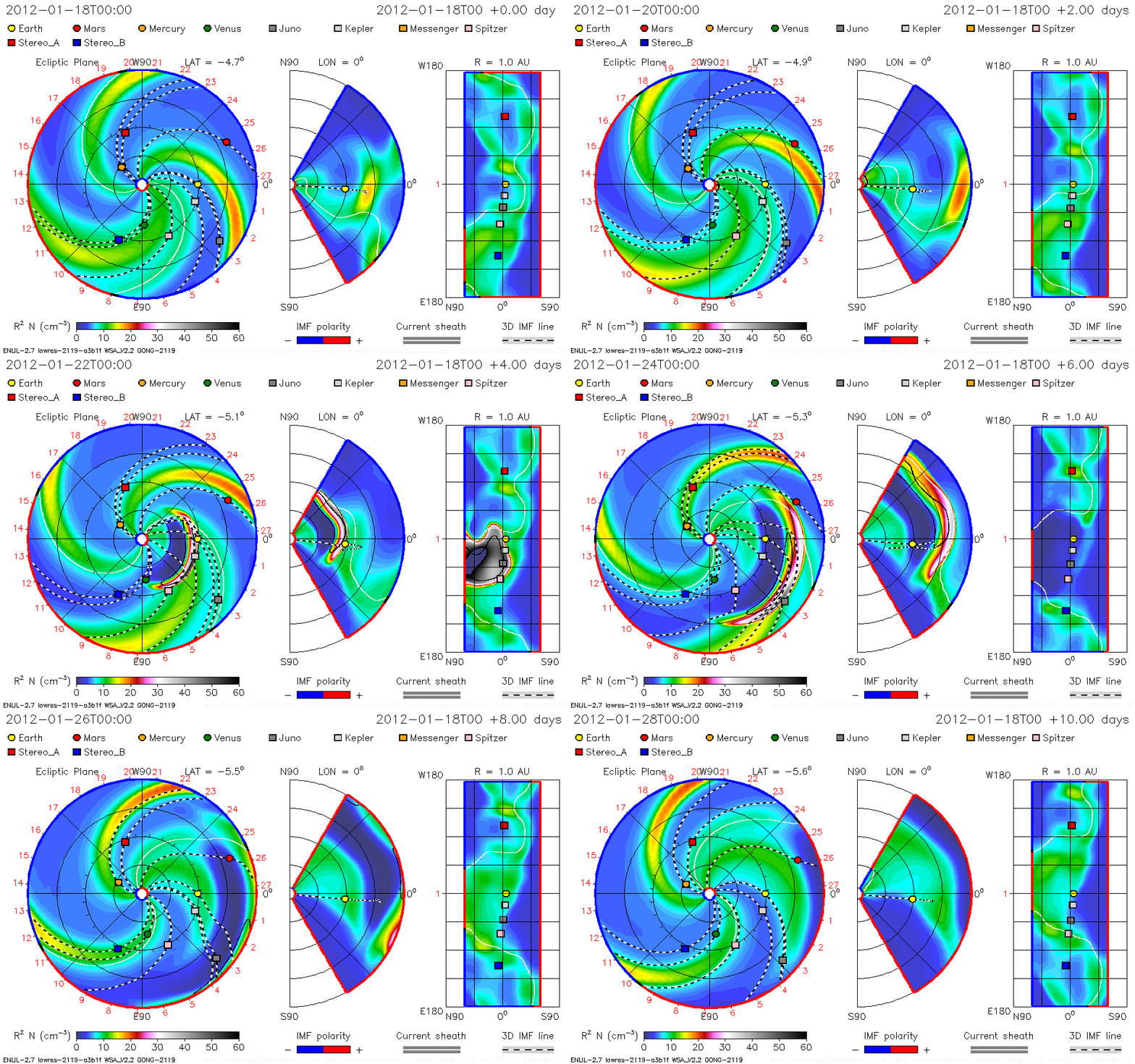
Here is a neat animation of the forecast, showing not only the Earth, but Mars, Mercury and Venus as well as a few spacecraft in orbit. The cloud is expected to hit here on Saturday, around 22:30 UT (plus or minus 7 hours). (The Space Weather Prediction Center has forecast that it will hit at high northern latitudes around 1:00 p.m. EST on Sunday, with the bulk of the disturbance on Monday.) Initially there were apparently fears that this would be a direct blast that could seriously threaten communications and satellites, but the Post reports that it is more likely going to be a glancing blow affecting high latitudes. It will reach Mars on January 24th.

We are heading toward a sunspot maximum in 2013, and sunspot activity and flares like this may increase. Another consequence of increasing sunspot activity is that the UV radiation levels increase from the sunspots. This activity "puffs up" the earth's atmosphere which puts drag on low-altitude space debris, causing it to slow down and eventually fall out of orbit.  Space debris has become a major concern for safety of the astronauts in orbit, and getting rid of some of it in this way is a good thing. I hadn't been aware, but in 2007 the Chinese "killed" one of their weather satellites in a test, creating over 3,000 pieces of debris bigger than golf-ball size. Only 6% of this debris has re-entered the earth's atmosphere.  There was also a collision of Cosmos 2251 and Iridium 33 satellites that created debris.

Could be some good aurora somewhere!

Here's more on CME's and sunspots from earlier posts: (1) The 1859 Solar Superstorm; (2) Solar Activity (and Newt Gingrich)--well, that's relevant today since it's the South Carolina Republican primary vote!!)

Tuesday, February 15, 2011

Major solar flare and coronal mass ejection--TODAY (Feb. 16)

The sun on 2/15/11  NASA SDO
NASA has just announced the first X-flare of the new solar cycle.

There are three categories of solar flares based on their brightness at wavelengths from 1-8 Angstroms.  X-flares are major flares that can trigger planet-wide radio blackouts and long-lasting radiation storms.  See this article on spaceweather.com for more information about solar flare classifications, and for updates as the flare heads toward earth. This eruption peaked at about 0200 Universal Time (1800 Central Time in the US) on February 15th.  This is the largest solar flare in four years. Last autumn, NASA warned that a peak in the solar activity in 2013 could cause serious geomagnetic storms with the potential to knock out electricity grids for days to months.

Since this flare also sent a coronal mass ejection (CME) toward the earth, geomagnetic storms are possible when the CME arrives in 36-48 hours, although at the moment the prediction is that it is unlikely that there will be communications problems nor that the astronauts are in danger. Might be some great aurora as well!

Here's the link to an earlier article I wrote on "Solar activity (and Newt Gingrich)."