Welcome!

This blog provides commentary on interesting geological events occurring around the world in the context of my own work. This work is, broadly, geological fluid dynamics. The events that I highlight here are those that resonate with my professional life and ideas, and my goal is to interpret them in the context of ideas I've developed in my research. The blog does not represent any particular research agenda. It is written on a personal basis and does not seek to represent the University of Illinois, where I am a professor of geology and physics. Enjoy Geology in Motion! I would be glad to be alerted to geologic events of interest to post here! I hope that this blog can provide current event materials that will make geology come alive.

Banner image is by Ludie Cochrane..

Susan Kieffer can be contacted at s1kieffer at gmail.com


Saturday, July 21, 2012

Tour de France and the dynamics of bicycle pelotons

After spending three months in Durham, England, and taken a vacation from blogging for six weeks (amazing what it does to the hit count on a blog!!), I thought that I'd restart with a look at the dynamics of the peloton that plays such a role in bicycle competitions since tonight is the next to final day of the Tour de France. Kudos to the apparent victor, British Bradley Wiggins!

I found a very interesting paper "The self-organized complex dynamics of bicycle pelotons," by Hugh Trenchard.  I do not have not got a citation for this paper, it appears to be a book chapter submission under revision, and is available here on the WWW. The link to the author on the top of the first page says that he's interested in self-organized complex adaptive systems, with special emphasis on the pelotons.  An eclectic interest and a very interesting paper. I hope that it does get published!

Briefly, a peloton is a group of cyclists riding in a group.  It can consist of as few as two cyclists, but amongst the competitive cycling community, it usually means a large group of cyclists riding in (frighteningly close) proximity. An indication of the massiveness and effects of the peloton was indicated today by a radio commentator who was at the roadside as the cyclists emerged from the French Pyrenees, describing the strong wind that they generated as the blew by and the smell of burning rubber from the hundreds of cyclists all using their brakes at the same time!

Cyclists in the front and, to a certain extent, on the sides, experience the highest air pressure and resistance to their motion, and cyclists behind the leaders or inside the periphery experience a reduced air pressure. Riders who are behind the leaders are "drafting." According to Trenchard's paper, the energy saved by being in a drafting position is reduced by 18% at 20 mph, 27% at 25 mph, and 39% at 40 km/hr for a peloton of eight riders. Cycling is an incredibly strategic competition, and stage races like the Tour de France that extend of many days and weeks are a complex mix of individual and team strategies. No rider can sustain the lead forever, and so riders on a team change leads frequently. If one individual has been designated as the team leader who all others are to support in order that the victory be his/hers, then team members subordinate their own desire for individual victory to support a team victory. This has had some interesting dynamics in the last days of the current Tour.

Trenchard presents two models for the dynamics of the peloton. The first is an energetic model that looks at individual, coupled, and globally-coupled energy output thresholds. The second is an economic model that incorporates competition and cooperation dynamics, using basic game theory.

Without going into any detail, I'll summarize a bit of the results of the energetic model.  Phase I ("Disordered-relaxed") begins immediately upon start of the race as the cyclists begin to accelerate in a pack.The pack is fairly disordered, low density, unstable, and undergoing increasing speeds and pack density. This phase can occur during the outset of a race or during temporary relaxations after periods of high energy output.  This phase can last only a few seconds in some instances before the onset of Phase II ("Peloton rotation/convection rolls"). In this phase, speed, power output and energy expenditure also increase but are not at the physiological thresholds of the riders. In this phase, the group has a maximum density. The system exhibits convection roll dynamics called "peloton rotations," not unlike the rotation of Emperor Penguins in the Antarctic or convection in Rayleigh-Bernard heating. This phase is stable and comprises the largest proportion of time during a typical race.

In Phase III ("Single paceline, synchronized") speeds are synchronized and riders align in single file. This is a phase of high power output and energy expenditure and riders are very near their physiological thresholds.

In Phase IV ("Disintegrated") riders are exhausted and the peloton disintegrates. There is a low density but still fairly high energy output. This phase is unstable, and may lead to a reintegration through phase I dynamics.

Wednesday, June 13, 2012

Taxis, balloons, kids, and a bit of dynamics

 
I spent last weekend in Edinburgh, Scotland, where I saw a wonderful parade. (Remember that taxi's in the U.K. have a very distinctive style! )

The taxi driver who took me from the train station to my hotel on the weekend when I arrived mentioned that on Tuesday the taxi drivers volunteered their services to take handicapped children on a parade and for a day at the sea--BBQ's, games and all-day fun.

They decorate their taxis with balloons for the day. Last year, he and his wife had risen at 4:00 a.m. to decorate their taxi with 300 balloons, only to have a strong wind come up and strip most of them off before the parade even started! 

Why does this qualify for a "fluid dynamics blog" (except for fun!)?
Because I'd never thought about how to attach 300 balloons to a car and keep them there for a day! Have you? 

They tie a mesh net on top of the car, and tie the balloons to the net. Unfortunately, the swaying of the balloons in the wind moves the net, which tends to damage the paint job on the car. My hat's off to these taxi drivers and their volunteer efforts.

Oh, yes--another taxi driver warned me in advance--they provide the kids with water guns to soak the spectators! Can you see the kid with the water gun in the photos!

Again, kudos to the taxi drivers who devote their day to this event!


Thursday, May 31, 2012

What can seismicity tell us about subterranean volcanic activity?

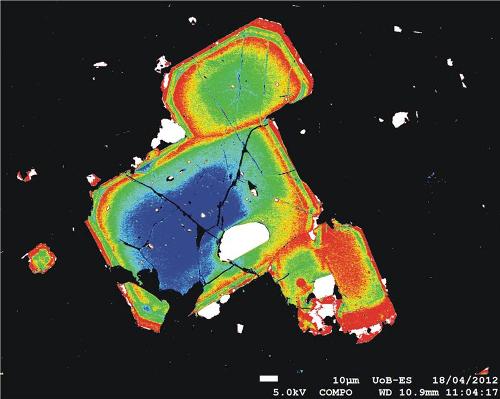
A zoned orthopyroxene. This example is NOT
from the paper being discussed. It is from here.
In a Science paper*** last week, Saunders et al. present a tantalizing relationship between episodes of seismicity at active volcanoes, the growth of rims on small crystals (of orthopyroxene), and intrusion of new batches of magma into shallow levels of the system. The underlying science is that the composition of crystals growing in a magma responds to any changes in the conditions of the magma--composition, volatile content, temperature, pressure, and oxidation state. Saunders et al. examined iron (Fe)-magnesium (Mg) zoning in 579 orthopyroxene crystals takenfrom Mount St. Helens eruptions between 1980 and 1986. They found four categories of zoned crystals: some with Fe-rich cores and Mg-rich rims, so-called 'reverse-zoned' crystals; some with Mg-rich cores and Fe-rich rims, so-called 'normal-zoned', multiply zoned, and patchy zoned. By modelling diffusion of elements they calculated that the crystals formed in <12 months. The authors attribute the zonation to changing oxygen fugacity and H2O concentrations.

The cores of the opx crystals appear to have been entrained from an old, partially crystallized magma. Normally zoned crystals may have resulted from rapid cooling of crystals suspended in a new magma pulse as they intrude into the reservoir, or of rapid crystallization induced by fluxing with CO2-rich gas. Reversely zoned crystals may have been produced as crystals already in the chamber are subjected to heating by the intruding magma. These crystals are first partially resorbed, and then overgrown with a Mg-rich zone that is in equilibrium with the new hotter, adjacent mel. Unzoned crystals are ambiguous and the authors offer several interpretations.

The authors then took the date that the crystal was erupted and subtracted the rim growth time to obtain the month in which the opx rim began, presumeably due to a magmatic perturbation. They plotted these dates on a graph of the seismicity and SO2 emission flux and found that the peaks in the growth dates corresponded to episodes of deep seismicity, especially in 1980 and 1982. The implication is that at least in some instances, the seismicity is related to intrusion of magma.

***Saunders, K., Blundy, J., Dohmen, R., and Cashman, K., Linking petrology and seismology at an active volcano, Science, 336, 1023-1027, 2012.

Friday, May 18, 2012

Landslide in Swiss Alps, phenomenal footage

On CNN today (May 18), there is an amazing video of a 300,000 cubic meters landslide in the Swiss alps. It's stable footage from a helicopter. Perhaps as impressive as the landslide are the obvious fractures in the ground that has not yet failed but will inevitably go. One of the rips goes right through a barn. It is at Preonzo, Switzerland, according to a YouTube version.

Thursday, May 17, 2012

The biggest sandbox in the world....?

 A: Seismic section with gamma-ray log
 B, C: Samples from upper part of upper sand
(white arrow in SWC in A)
(I'm being a bit lazy here, because I'm working on a PC instead of my trusty Mac and can't figure out even the simplest operations, so I'm  just cutting-pasting in directly from this very interesting article in Geology "World's largest extrusive body of sand?" by Helge Loseeth, Nuno Rodrigues, and Peter Cobbold,Geology, 40(5), 467-470, 2012 )

During the 1812 New Madrid earthquake (southeastern United States), individual bodies of sand as much as 2 m thick appeared patchily over a 4000 km2 area. The sand volume was estimated to be to be 105–107 m3 and there were claims that it was the largest reported extrusive sand (extrudite). There have been no reports of extrusive sands as voluminous as several cubic kilometers. Typically, extrusive sands connect to their parent sandbody or sandbodies in the subsurface via hydraulic fractures.

Using three-dimensional seismic and well data from the northern North Sea, Loseth and colleagues describe a large (10 km3) body of sand and interpret it as extrusive. To their knowledge, this is the world's largest such sandbody. It would bury Manhattan, New York (60 km2), under 160 m of sand, or the whole of London, UK (1579 km2), under 6 m of sand. This sand vented to the seafloor, when it was more than 500 m deep, during the Pleistocene glacial period. The sandbody (1) covers an area of more than 260 km2, (2) is up to 125 m thick, (3) fills low areas around mounds, which formed when underlying sand injectites lifted the overburden, (4) wedges out, away from a central thick zone, (5) is locally absent along irregular ditches, 20 km long and up to 50 m deep, which overlie feeders on the flanks of the mounds, and (6) consists of fine-grained to medium-grained, sub-rounded to rounded grains.

A pretty big sandbox to play in!!

Tuesday, May 15, 2012

Monowai volcano: fast outpouring of magma observed over 5 days

Bathymetry of summit of Monowai Cone May/June 2011.
How fast can a volcano spew out magma? This is a question that has perplexed volcanologist for a very long time.  Recently a team of scientists, led by A.B. Watts of Oxford University,  conducting a routine bathymetric survey onboard the research vessel  SONNE, were fortunate enough to be in the proximity of Monowai seamount volcano when a dramatic eruption occurred.**  Monowai is located along the 2,500 km-long Tonga-Kermadec Arc, where a submarine volcano can be found approximately every 50 km.
Eruptive volume versus duration of magmatism for submarine volcanoes.
Monowai is not small. It is a 10-12 km-wide strato-volcanoe approximately 1 km high with a 7-10 km wide caldera in its summit, approximately 0.6 km deep. Since it was first discovered in 1944 it has had a history of activity (discoloured water emanations and seismic ity). On May 14, 2011, the scientific team observed gassy discoloured water on the summit of the Monowai Cone. Three days later, a swarm of seismic events began and lasted for 5 days. On June 1, after the seismic activity subsided, the ship returned and carried out a second survey of the cone. They found significant changes in depth at the volcano. The main differences were (1) an increase in depth of up to 18.8 meters attributed to collapse structures on the flanks of the volcano, and (2) a decrease in depth of up to 71.9 m due to growth by eruption of new lava flows. The most striking feature of the surveys was a new cone near the summit. From its dimensions (100 m diameter at its base, at least 40 m high), it appears that about 0.00875 cubic kilometres of magma was erupted, most likely during the 5-day swarm of seismic activity. Extrapolating these rates to annual output, Monowai joins Kilauea, Iceland, Montserrat, the Azores, Hawaii, and the Canary Islands withoutput on the order of 0.1 cubic kilometres per year.

**Reported in A.B. Watts, et al., Rapid rates of growth and collapse of Monowai submarine volcano in the Kermadec Arc, Nature Geoscience, Advance publication, doi: 10.1038/NGE01473, posted May 13, 2012. Featured on Geology.com on May 15, 2012.

Saturday, May 5, 2012

Supermoon, Earth, Io and Enceladus

Tonight is a much publicized "supermoon,"a celestial event with the moon makes its annual closest approach to the earth and is opposite the sun giving a full moon.** The moon's orbit around the earth is elliptical, coming as close as 222,000 miles (perigee) and as far as 252,000 miles (apogee). It will appear bigger and brighter than other full moons. According to space.com, the moon will appear 14% larger and 30% brighter than other times of the year.

The moon will appear most spectacular right around moonrise, though this is largely due to an optical illusion rather than to its closer proximity. The exact cause of this illusion is debated. One theory is that the presence of objects, such as trees or buildings in the foreground, make the eye focus differently, and another holds that the brain interprets distant objects as wider.

Since the earth tides (both in the solid earth and in its oceans) are caused by the gravitational attraction of the moon and sun (mostly the moon), tides are expected to be higher than normal, but not by enough to get all excited about. NASA estimates about 1" higher than usual, possibly somewhat higher depending on local geography, and also amplified if there are storms in the area.

Example of amplified tides due to supermoon. This record,
extracted  from a NASA video of a longer time-record.
There is a lot of speculation on the WWW about possible supermoon effects on earthquakes and volcanic eruptions (good grief--including the Tohoku earthquake in 2011. For a debunking of this, see here.) There is no scientific evidence to suggest any dramatic effects associated with supermoons. There are, however, two other places in the solar system where moons do cause spectacular effects.

One is on Io, a satellite of Jupiter. The gravity of Jupiter and its largest moon Ganymede, with help from two other moons Europa and Ganymede, cause tides over 300 feet, as high as a 30 story building. This deformation causes such heating in the interior of Io that it spouts fiery volcanoes of sulfur and sulfur dioxide. The other is on Enceladus, a frigid satellite of Saturn. Enceladus is only 80 K, 80 degrees above absolute zero, at its equator, but at its south pole, temperatures as high as 180 K have been measured. In that region, icy plumes of water ice spurt out into the vacuum of space. The tides on Io and their effect in producing volcanism were figured out by three scientists***  even before the Voyager spacecraft arrived there and observed the volcanism. The tides on Enceladus and their relation to the plumes are still not fully understood. Two different satellites, two different manifestations of tidal energy.

**Here is an excellent article about the event from EarthSky.org.
***Peale, Cassen, Reynolds, Science, 203, 4383, pp. 892-894, 1979

Wednesday, May 2, 2012

James Hutton and John Kay

Caricature of James Hutton by
John Kay, about 1787
While in Edinburgh, we came across a bookstore selling all sorts of maps.  We asked the owner if he had any works related to James Hutton, and he said 'no', but wondered if we had ever seen the caricature shown to the left.  Unable to order a copy for us, he xeroxed the famous print of Hutton examining the rocks, and the rocks speaking back to him. How many faces can you see?

John Kay (1742-1826) began his career apprenticed to a barber, but in 1785 his hobby of etching caricatures of local celebrities was well enough received that he abandoned his barber career and opened a small print shop in Parliament Square in Edinburgh, where he fluorished. His works were collected by Hugh Paton and published as a series of six volumes entitled  "A series of original portraits and caricature etchings by the late John Kay." Publication dates were, I think, 1838 and 1842 for the volumes, nearly 50 years after Hutton's death.

The biography of Hutton in Paton's volume is interesting and gives a flavor for how the natural sciences were presented at the time when the sciences were fluorishing.  "Dr. Hutton was an ingenious philosopher, remarkable for the unaffected simplicity of hismanner, and much esteemed by the society in which he moved. In his dress he very much resembled a Quaker, with the exception that he wore a cocked hat." After some abortive attempts at law, medicine, and chemistry, in 1786 he devoted himself to "scientific pursuits" for the rest of his life. His first book was @Considerations on the Nature, Quality, and Distinctions of Coal and Calm," and his next were "Theory of the Earth," and "A Theory of Rain," both published in the first volume of the Transactions of the Royal Society of Edinburgh. His Theory of Rain becamse a @subject of controversy, which was conducted with much warmth." He then moved on to more metaphysical subjects, and was writing even on the day of his death in 1797 after an illness of about 5 years. John Playfair (1748 – 1819) popularized Hutton's work with his "Illustrations of the Huttonian Theory of the Earth", published in 1802.

Friday, April 13, 2012

Severe tornado outbreak predicted for the weekend; record outbreaks

Storms on Friday, 4/13/2012
From weather.com
In a very unusual move, NOAA issued a severe weather/tornado alert two days in advance for this upcoming weekend. I first read of this from Dan's Wild Wild Science Journal on the American Geophysical Union Blogosphere. Dan (Satterfield) is a meteorologist on air who writes a blog for AGU aimed at junior high-school audiences and up.

Unfortunately, Joplin, Missouri, so hard-hit just a year ago, is getting pummeled again with severe weather today and forecast into the weekend.

Here's the NOAA detailed description.

My simplistic view of the spring storm system in the midwest is that cold air from Canada collides with warm air from the Gulf of Mexico, leading to our spring thunderstorms and tornado season.  The scenario for this weekend seems much more complicated.  An "impressive upper-level low" is moving out across the four-corners region (where New Mexico, Arizona, Colorado and Utah come together) at the same time as a powerful mid-level jet stream moves northeastward into the southern and central plains. This means that there is abundant moisture available in the lower layers of the atmosphere, and strong shearing winds at low levels to spin up parts of the storms into tornadoes. The third ingredient in place is a "cap" to hold the warm moist air near the ground until it "explosively" breaks through the cap in severe storms.  The "cap" in this instance is provided by warm dry desert air coming in from the desert southwest four-corner region. The geography then of Canada to the north, the Gulf of Mexico to the south, and the dry desert to the southwest makes the U.S. the tornado capital of the world.

The tornado outbreak from April 25-28, 2011 was the largest tornado outbreak recorded, with 358 tornadoes. In 1974, 148 tornadoes occurred in the U.S. and Canada (see this post on "tornado alley" in Canada.) That earlier outbreak has the distinction of severe tornadoes with 6 F5 and 24 F4 tornadoes.

Other posts on tornadoes: multivortex tornado, Monster Alabama tornado, February 2012 tornado, brutal weather April, 2011.

Thursday, April 12, 2012

A geologic pilgrimage: Edinburgh, Scotland--The Enlightenment and James Hutton

This blog is broadly about fluid mechanics in geology, and eventually I’ll get to fluids in this post! But, along the way...some early history of geology, and a pilgrimage to honor James Hutton, the discoverer of 'deep time.'
This is the section of Grayfriars where Hutton is buried, the
plaque shown below is  the white rectangle in the middle left.
Photos in this post by G. Lopez

From 1730 to about 1790, Edinburgh, Scotland, enjoyed a period of incredible intellectual focus and productivity, the "Scottish Enlightenment." For an excellent overview how our modern concepts of time evolved and the four instrumental scientists in this evolution (Copernicus, Galileo, Hutton, and Darwin), see Jack Repchek's book "The Man who Found Time: James Hutton and the Discovery of the Earth's Antiquity," particularly the Prologue.


During Hutton's time in Edinburgh, industry, commerce, agriculture, science, and the arts flourished.  David Hume (philosopher, historian), Adam Smith (economist), and Joseph Black (chemist) prospered during this time. And, it was here in Edinburgh that the landowner, farmer, agriculturalist, physician, and natural philosopher, Hutton, founded our modern science of geology.  


Why was Hutton so important? At the time of Hutton, many natural scientists believed that all rocks were formed underwater, the so-called "Neptunist" school of thought, championed by Abraham Gottlob Werner. Hutton’s ideas about the evolution of the earth required long times, the so-called “deep time” popularized by John McPhee in 1980.   He also introduced and rigorously pursued the idea of “falsification” of ideas in science: that conjectures should be posed in a way that leads to verifiable predictions, and in a way that can be tested as false. Without Hutton’s work, Darwin’s work in the next century would have been impossible. In fact, Hutton had recognized natural selection as a “beautiful contrivance”, more than a half century before Darwin. 


For a geologist like myself, a visit Edinburgh feels rather like a pilgrimage, especially when undertaken on Easter Weekend! Here, nearly in the midst of Edinburgh and all within walking distance, are three sites of special interest--Hutton's "section," Hutton's "rock," and Hutton's grave. Locating and getting to these sites, however, turned out to not be trivial task.

Trips to geologic sites of interest do not always go as planned. Guidebooks may be outdated, outcrops can be altered by quarrying activities or just normal weathering. A few years ago, my husband and I were in southern Germany and I was trying to collect some rocks brought up from deep in the crust ("xenoliths") during volcanic eruptions by visiting various rock quarries. I had, in accord with the Geologic Code of Conduct, successfully contacted some quarry owners in advance, but couldn't get hold of one at the most important site. I was resigned to the fact that I might visit, but not collect, at that one if I could even find it. Nevertheless, photos of that quarry would be helpful in my research. We searched and searched but couldn’t find that quarry (we were working from an old guidebook and the quarry may have been closed). We had, however, found several quarries that were good, but nothing like the superb and elusive one that we were searching for.  Finally, toward the end of the day, my patient husband said "Do you want to keep searching for El Dorado? Or, go back to the sites we already found." Since that day, "El Dorado" has had a special meaning for us--the goal of a search that is not going well. On this 4-day trip to Edinburgh, it turned out that there were three El Dorados--the grave, the section, and the rock!

According to one source (*McIntyre and McKirdy, p. 45) Hutton’s grave was unmarked for 150 years after his death in 1797, at the age of 71, and he was buried in an “obscure plot” in what is now known as Grayfriars Kirkyard and cemetery. We began our quest by walking there on a drizzly Scottish day. (Grayfriars is more famous for the dog, Bobby, that guarded his master’s grave for 16 years than for being the site of Hutton’s grave, and tourists flock to see the dog, who occupies front and center of the entrance!) There we found gravestones dating back to the 1600's, but alas, no clue about how to find Hutton.  Finally, on our way out of the churchyard, we discovered the index map, and also discovered that the grave was behind a locked gate. Failure...El Dorado #1. 

The only sign in the vicinity of Hutton's section and
Hutton's rock! 
Then, we walked about a mile toward a visitor center that lies at the base of two very famous geologic features in Edinburgh--Salisbury Crags, and Arthur's Seat. Somewhere up there lay Eldorado’s #2 and #3. The climb up these features seemed intimidating!

The next day, we started over, revisiting Greyfriars church, where we found a most helpful volunteer, Wally, who eagerly produced a key and walked with us to unlock the gate. There, somewhat weedy and overgrown, was indeed Hutton’s grave with a plaque on the wall above it (the two photos above).  On the stroll back to the church, I naively asked whether this was an Anglican church—big mistake! Need to do my history work when I get back hom3! Church of Scotland!!

We then hopped a bus back to the visitor center for Holyrood Park and, with our guidebook, found the “Volunteers' Walk,” a great path up into the saddle between Salisbury Crags and Arthur's seat. These two features are the most spectacular of several volcanic dykes and sills that were intruded into the ancient sedimentary rocks in this area.  Hills on the skyline in Edinburgh are typically underlain by volcanic materials such as these, and Edinburgh Castle famously is built on such a feature. Volunteers Walk is a fairly gentle and well groomed path up past Hunter's Bog, bringing  us to "The Hause", and El Dorado #2, Hutton's section, on the back-side (for us) of Salisbury Crags.

Fluid dynamics alert!! At Hutton’s section, a volcanic magma rising toward the surface was trapped between beds of the sandstones in the area forming a feature called a “sill.” Beneath this sill are well-bedded sediments of the Cementstone Group, vaguely red and white in color but heavily stained on their surfaces.  At the contact between the magma and the sediments, the sedimentary rocks were “baked” by the heat of the magma as it was intruded between the layers, and the magma was chilled by the sedimentary rocks, forming a glassy “skin” about a centimeter thick. The volcanic magma has crumpled and rotated the sediments, and in places, engulfed them (photo above with deformed sediments sweeping upward).  Such deformation could not be explained by the Neptunists--those who argued at the time that all rocks were formed underwater--and this site became critical for Hutton in proving his theories.

About 100 meters further along the path here (west?)  lies a very undistinguished looking rock, Hutton’s Rock.  Although nearly impossible to see today because of the weathering and staining, Hutton recognized that the magma (a teschenite) had been extensively altered by hematite (Fe3O4), and that a vein very rich in hematite and several centimeters in thickness cuts through the rock.  He saved it from the quarrying operations and, amazingly, it has remained in place for more than two centuries (possibly because it is so undistinguished in appearance!)

Alert readers: The Geological Code of Conduct is an agreement signed by all European countries regarding visiting and preserving geological outcrops. Please read and obey.

All in all, a successful trip with El Dorado’s #1,2 and 3 all found!

______________________


*Additional references: Lothian Geology, An Excursion Guide, A.D. McAdam and E.N.K. Clarkson, published by the Edinburgh Geological Society, 1960 and updated and reprinted in 1996.  We got this book at the Carson Clark Gallery (a map center) and the owner claims that a few years ago he bought up all few hundred copies that were still in existence!)


*James Hutton, The Founder of Modern Geology, by D.B. Mcintyre and A. McKirdy, a revised and amended addition published in 2001 by the National Museums of Scotland.


Indonesia 8.6 earthquake unusually large for a strike-slip event

Geology.com has featured an article in the Washington Post about yesterday's Indonesian earthquake that I call your attention to, but won't repeat here.

http://www.washingtonpost.com/national/health-science/scientists-magnitude-86-indonesia-jolt-was-unusually-large-for-a-strike-slip-quake/2012/04/11/gIQAduJCBT_story.html

Wednesday, March 28, 2012

Man buried for four hours in 4' deep mud: thixotropic, rheoplectic, or something else?

Man immersed in mud for four hours in Atlanta, Georgia


An amazing event and rescue in Atlanta, Georgia, was briefly on the CNN.com news this morning. It's not clear how the story was pieced together yet, and the rescuers have no idea of the identity of the man involved or how he came to be stuck in mud.  At a construction site, there was a pool of mud estimated to be four feet deep. It appears that the man did not fall from the site, because it would have been a 30' fall and, aside from his mud trauma, had no other injuries.  He apparently wandered into the mud, and struggled to get out of it for a few hours before succumbing to cold and exhaustion (it was 50 F) in Atlanta this morning. Rescuers could not reach him without danger of becoming trapped in the mud themselves. Eventually a female paramedic reached him and kept his airways open until rescuers, using boards from the nearby construction site to fashion a bridge out to him, were able to pull him out. The video above shows his rescue, and he is apparently doing fine in the hospital.

The video compared this situation to quicksand, but I'm not sure that the analogy is correct. Quicksand is an example of a "thixotropic" fluid, one that starts as a solid and becomes weaker when it is shaken, aggitated or stressed. If my interpretation of the video is correct, this mud became stronger as he struggled so it may be an example of a "rheopectic" material, one whose viscosity increases the longer it undergoes shearing. Such materials are fairly rare, but of increasing interest in military and sports applications where a major goal is to create materials that reduce the stress due to impact. For instance, a shoe that incorporates rheoplectic materials in its cushioning might help protect the feet of runners, jumpers, and hurdlers. Helmets and body armors with such materials would reduce body trauma from projectiles.

Or it may be some other wonderful wierd behavior! Readers comments welcome!

Monday, March 19, 2012

Blogger meets blogger, and a request for help from the readers!

"Blogger meets blogger" is not a story about a romance!

It's a story about how, in spite of perceptions of many academics to the contrary, serious scientific collaborations can emerge from blogging! A bit less than two years ago, I started this blog out of frustration with writer's block on a book project, and found that I could relax, whip off a post in a fairly short time (most of the time...), and then get back to book writing. Then I found that posting was a wonderful way to learn, and document, new science day-by-day.  It became a fun part of my research life.  (At one point, I was challenging myself to find something broadly relevant to "geology in motion," that is, geological fluid dynamics, in the news every day.  After having to write one post about how the Champaign fire department responded to a mystery parcel left on the street and make it relevant to geological fluid dynamics, I gave up that angle for source material!)

In May, 2010, shortly after I started my blog, I emailed a geoblogger and professor at Durham University in the U.K. to ask if he could check a post that I had done about the landslide at Attabad, Pakistan, for accuracy and proper referencing to his work. His blog is the Landslide Blog, and he, Professor David Petley, graciously replied, and became (inadvertently, I'm sure) my mentor on blogging. And, now, nearly two years, and 138 emails later, I am sitting in an office across the hall from him to begin our collaboration on landslides and their response to constrictions. I am here thanks to a joint European Union/Durham University scheme, and am a guest of the Institute of Hazard, Risk and Resilience, We will be posting the results of our work, as we go, on both of our blogs, sometimes independently and sometimes jointly. In that spirit, from here on I  simply copied from Dave's description on his blog this morning, including our request for your help:

So, after that rather long introduction, we have a request for you. In our work together we are exploring the ways in which landslides behave as they pass through constrictions – i.e. narrowing points in the channel or track. Lots of work has been undertaken on rivers as they pass through constritions, but very little about landslides. We both feel that understanding behaviour in such settings might tell us a great deal about landslide dynamics and mechanics.
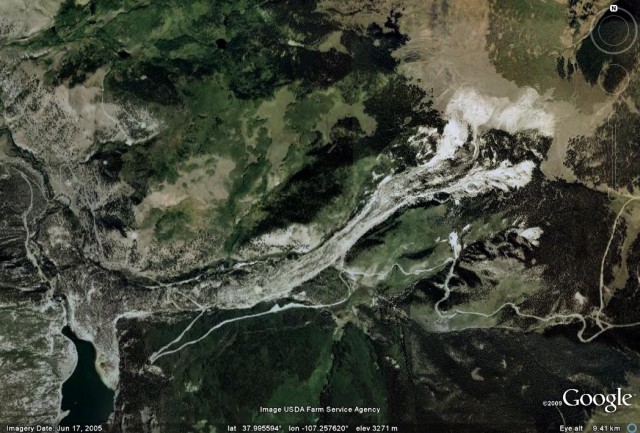
So this is where you can play a role. We are trying to create a database of landslides that have passed through (or been stopped by) a constriction. By this we mean a point in which the track or channel narrows. An example is the Slumgullion landslide in Colorado, which goes through a fairly gentle constriction along track (images from my earlier post about the landslide):


Actually there is a second constriction (abeit a smaller one) further down the track as well, if you look carefully.
So, we are inviting readers to send us examples of landslides with constrictions. It can be any type of landslide in any environment, with any type of constriction (this could be natural or artificial). The key is that we are interested in places in which the track of the landslide is narrowed by the topography. Please provide examples either by emailing them to me (d.n.petley@durham.ac.uk)or me (skieffer@illinois.edu) or as a comment on this post.
Thanks – this is a really interesting science project, not least because it has come about as a result of blogging. It is even more fun to think that the examples that we use might be blog generated as well! We will of course acknowedge your help and can make the data available in due course.I

Sunday, March 18, 2012

A most unusual river meander: The River Wear at Durham, England

File:Durham 1610.jpg
http://en.wikipedia.org/wiki/File:Durham_1610.jpg
I have seen river meanders in a number of different settings--along the relatively flat stretches of rivers in the Midwest of the U.S., in bedrock along the Colorado River in Arizona, and, most impressively, in the famous Goosenecks of the San Juan River. These meanders were clearly formed at an earlier time and, we often presume from theories of river meandering, on nearly flat, erodible ground. They are also meanders that I've only seen by river rafting and hiking through the desert terrain of the Southwest.

Tonight I sit in acomfortable apartment at Durham University (England), wrapped in a river meander that has played a role in history. The river in view from my apartment window flows in a stately manner that we would call "subcritical" in the hydraulics terminology.  Rowing teams are practicing on the flat water for competition, which culminates for northern England on the second weekend in June with the championships. The enclosed ground, far from the isolated desert peninsulas in such settings in the Southwest, comprises the city of Durham, a World Heritage site for its culture and geography. It is a very different perspective to be sitting in a comfortable apartment high on the bluffs on the peninsula enclosed by the meander than to be camping on a beach at the base of such bluffs!

The meander looks, at first, like a classic incised meander--formed earlier in time on flatter land, and then incised into underlying bedrock as the land was lifted through tectonic processes. But, unlike the meanders in the American southwest, this meander has survided glaciation. How did that happen? We think of glaciers as giant bulldozers that flatten, or at least, subdue, the high ground that they traverse--the American Midwest. The ground of the peninsula enclosed by the meander is anything but flat--so steep and hilly that in the few days that we've been here, we've only seen one bicyclist (leaning hard on her brakes as she went downhill). Everyone walks instead of cycles! How did all this topography survive the glaciation? It is strikingly different from our glaciated Midwest.

Glaciation in this area reached its peak about 18,500 years ago. The glaciers receded starting about then, but paused right here where I am sitting as a guest of Durham University about 14,000 years ago.  I can see that I might like to stay in this fantastic place for 500 years, but why would a glacier pause here for that long? The answer will, hopefully, be in a future post!

Readers might enjoy this geographer-at-large blog!

Friday, March 9, 2012

Galactic Champagne: bubbles, star formation, pretty pictures, and citizen scientists!

A sample image used by citizen scientists to locate "bubbles" in
the Milky Way. (left) raw image; (center) image showing work
of some of the volunteers; (right) the final image showing which
features have met the criteria for being "bubbles." Full explanation
in the text. Image: NASA/JPL-Caltech/Oxford University
More than 35,000 "citizen scientists" have identified 5,000 "bubbles" in images of our galaxy.  (Wouldn't it be wonderful if even a fraction of these people found this blog!!) Their work has increased the number of such objects that have been identified by a factor of 10. More details about the Milky Way Project can be found here by following the "Click here" link. According to the statistics listed at the bottom of the page, 527,000 images have been examined, and 662,000 bubbles have been drawn.

Each citizen scientist takes an image, and draws circles, arcs, fractions of circles, and identifies other features, using a special drawing program, not unlike many of the commercial drafting packages, just customized to this specific effort.  A special tool allows the researcher to draw a circular band around an object, center it on the object, alter the width of the band, and change its shape (e.g., toward an ellipse, or to allow an indent on some segment of it). Since circles may overlap, other tools allow fractions of a circle to be identified.  After doing this, the researchers can flag the image as one of their "favorites", and move on to another image. It all seems like great fun, which is at least partially what science should be about! I don't know if they are still accepting new citizen scientists into the project, but details are on the link provided in the first paragraph.

Each citizen scientist creates an edited image showing the circles and segments that they have identified.  These are laid on top of each other to create a so-called "heat map," the middle image above. Features that have been identified by many users then jump out as being the brightest on the heat maps. At least five volunteers must flag a "candidate bubble" before it is included in the final catalogue of bubbles (right). The brightness of the bubble in the catalog is determined by its "hit rate," the fraction of users that traced it out (for some reason, this reminds me of a beauty contest, with elements of both beauty and popularity....). The faintest ones in the image above were identified by about 10% of the researchers, the solid ones by 50% or more.


The data come from two instruments on Spitzer: the Spitzer Galactic Legacy Infrared Mid-Plane Survey Extraordinaire (fortunately abbreviated to GLIMPSE--and makes me appreciate the addition of "Extraordinaire" to the instrument name! Someone has a sense of humor), and the Multiband Imaging Photometer for Spitzer Galactic (MIPSGAL) surveys. Spitzer is a space telescope launched in 2003, the "final element in NASA's Great Observatories Program." The wavelength covered is 3-180 microns, that is, in the infrared region of the spectrum.  It catches thermal radiation emitted from objects. Spitzer is, currently 161 million kilometers from the earth.

Young, hot stars blow bubbles into the gas and dust of the Milky Way. What are the bubbles? Interestingly, the press release doesn't discuss this at all, and although the press release gives the "authors of the paper," it doesn't say what paper, or where it was published. (Grrrr....come on, press offices, at least give us a hint...). As far as I can tell, when young stars coalesce out of the spinning gas and dust in the galaxy, they collapsing in on themselves due to their own weight.  This process generates heat and sets up the combustion in the young stars. Excess material appears to be shed in order to slow down the rotation of the clump, and to prevent it from breaking apart.  Traditionally, it was thought that the stars shed this material in the form of a pair supersonic jet streams, not as spherical bubbles.  Now it appears that the bubbles may be the excess material.   

The distribution of bubbles in 3-D is interesting and potentially provides hints about structure in the Milky Way. For example, there are more bubbles off-center of the Milky Way than in its center. This has surprised the scientists because they expected star formation to be strongest where the most dense gas is, that is, at the center. This is a fairly new and exciting area of astronomy (the last 5 years?) and is clearly going to take me more time for me to sort this out.


Wednesday, March 7, 2012

X5-class solar flare on its way!

Northern lights over Lake Superior
Photo by Shawn Malone, available on spaceweather.com

A huge X5-class eruption at 00:28 UT, March 7, is heading toward earth (a mild storm had already started prior to the X5 class one). This CME is coming out of  sunspot group 1429. X-class flares are major events that can trigger "planetwide radio blackouts and long-lasting radiation storms." On another scale (of magnetic field intensity?), the Kp-index, this is a 5-6 event. A Kp index of 5 or greater indicates storm-level geomagnetic activity. These storms, in turn, are associated with charging of surfaces on satellites, and with increased atmospheric drag on satellites as the atmosphere inflates under the influence of the event.

The CME is expected to reach earth on March 8th at 0625 UT (+/1 7 hours). If I'm doing my time-zones right, that's about 10:25 p.m. tonight Central Standard Time here in Illinois.  This was the strongest CME in 5 years.  Have already had high-frequency radio blackouts, could have power grid outages... This is kind of a fun, "energetic" description of the "sun going 'boom;!"


Thursday, March 1, 2012

Tornado season...again..and it's only February

National Weather Service map for February 29
Yesterday was a grim day for the midwest and especially southern Illinois. The midwest was hit by a huge storm system that spawned several tornados, one of which was an intensity F4 out of the scale of F5. (Notice the yellow area on the NWS map to the left.)  12 people have died, and several hundred were injured. Six people were killed in the small town of Harrisburg, IL. In an eerie similarity to events last year in Joplin, Missouri, the medical center in Harrisburg was severly damaged by the tornado. Three of the deaths were in Missouri, and three in Tennessee.Tornados were also reported in Kentucky, and winds in excess of 100 mph were reported in northwestern Alabama.

This has been one of the wierdest winters I've experienced in my 10 years in Illinois--nearly snowless and warm. Yesterday it was 56 by 8:00 in the morning as the winds blew (very strongly) up from the Gulf of Mexico--that's the dark brown area extending through central Illinois and Indiana.  On the other hand, not all that far away, Michigan got hit with snow and freezing rain (pink and purple areas up near Canada). I have always wished that weather maps didn't stop at the border--friends in Toronto were also getting walloped by snow and freezing rain.

Here's a handy reference: a map of temperature extremes for whatever days you want to specify from Weather Underground.  It's showing record high temperatures in the mid-west, and record cold temperatures in the southwest and northwest. It was just created this week by Dr. Jeff Masters to allow viewers to look at record extremes, both in the US and internationally. Instructions for using it in detail are under Masters blog entry on the lower right adjacent to the map.

Wednesday, February 29, 2012

James Cameron, director of the Titanic, racing Richard Branson, to the Challenger Deep

The oceanography of the Challenger Deep
Graphic from CNN.com here
The Challenger Deep is the deepest known part of the ocean, lying in the Mariana Trench (a subduction zone feature) near Guam. The Mariana Trench is a 1600 mile-long, 43 miles across, formed by subduction of the Pacific Plate under the Mariana Plate.


It has only been visited once before by humans when Navy Lieutenant Don Walsh and the Swiss explorer (deceased) Jackques Piccard rode in their submersible, Trieste, to its bottom. In their descent, the outer layer of their porthole cracked when they were about five miles down, and still a mile above their destination.  The Triest was the first wholly self-contained submarine to make the venture. It was a giant, cigar-shaped "balloon" filled with 22,500 gallons of petrol--which is lighter than water--to provide buoyancy. Beneath this ballon was a tiny steel sphere, 7 feet in diameter, holding the two adventurers.  It had nine-tons of iron pellets attached to make it sink. These were then jettisoned on the ocean floor.

There is apparently a high-competitive race going on between Cameron, who has been preparing for this rather secretly for five years, and Richard Branson, who has built an airplane-shaped Virgin Oceanic submarine. The third competitor is Patrick Lahey, the president of a small Central Florida company, Triton Submarines. Cameron's submersible is being built by Australian engineers, and the goal is to film in 3D at the bottom.

Why the race? $10,000,000 will be awarded by the X-Prize Foundation, a nonprofit organization that aims to inspire radical breakthroughs that will benefit humanity. The Deep is 35,814 feet below the ocean surface, a mile deeper than Everest is high.

What's so exciting about the Challenger Deep? For biologists, it's the possibility of documenting some of the estimated 750,000 species of marine life that we haven't found yet (and this excludes the billion estimated unidentified microbes).

According to a 2010 article in the DailyMail.co.uk, Cameron plans to film parts of an Avatar sequel down there. Let's hope that he's successful!

Sunday, February 5, 2012

Update on the trial of Italian Seismologists in L'Aquila

L'Aquila, central Italy. AP Photo/Guardia Forestale, HO
from here
Last fall, six Italian seismologists and one government official were accused of manslaughter involving victims who perished in the 2009 earthquake that devastated the city of L'Aquila, killing 309 people. The scientists were members of a government advisory body, the National Commission for the Forecast and Prevention of Major Risks. The prosecutor of L'Aquila contended that they had falsely reassured the public about the likelihood of the earthquake.  The prosecutor acknowledged that earthquakes cannot be predicted, but he accused the scientists of misrepresenting the scientific uncertainty.  The accusation focuses particularly on the government official, Bernardo De Bernardinis, at the time the deputy technical head of Italy's Civil Protection Agency, quoting him as saying "The scientific community tells me there is no danger because there is an ongoing discharge of energy. The situation looks favorable." 

The scientists had been called to a meeting that had been charged with assessing the risk of increased seismic activity in the area. The scientists contended from the beginning that they did not make such statements, and have pointed out that that particular statement does not appear in the minutes of the meeting. The trial is scheduled for February 8, 2012, a few days from now.

In a new development, a wiretap revealed by the Italian newspaper La Repubblica, quotes a conversation on the day before (or week before??**) the meeting between Guido Bertolaso, then head of the Civil Protection, and Daniela Stati, an officer in the L'Aquila Provincial Administration. Bertolaso says "I will send them [the seismologists now on trial] there mostly as a media move. They are the best experts in Italy, and they will say that it is better to have a hundred shocks at 4 Richter than silence, because a hundred shocks release energy, so that there will never be the big one." If this wire tap conversation indicates that the Civil Protection had already decided the outcome before the meeting, the scientists may have good support for their argument that they never had a chance to make a serious risk assessment during the meeting.

Bertolaso has been scheduled to appear as a witness during the trial on February 8. He is now under investigation and it is possible that he will also be charged with manslaughter, though whether or not he will be included in the on-going trial or in a separate new trial is uncertain. The trial of the scientists and De Bernardinis began last fall, has nearly 300 witnesses, and is likely to last through much of 2012. Scientists involved with risk assessment are very concerned about the issues here and more than 5000, myself included, signed a letter, which you can read here, sent to President Giorgia Napolitano through the American Association for the Advancement of Science.  At the time of the letter, it appeared that the scientists were being charged with failure to predict the earthquake, not the current charges of misleading the public about the hazard. It is a very complex case. 

**It's very interesting that the Nature report and the Science report, both issued on January 26, have somewhat different facts and dates.

More information about the situation last fall is here. The Nature site about the wiretap development is here, and the Science article is here. The Science article has an inconsistency about whether the call was a week or just a day before the meeting.

Thursday, February 2, 2012

Europe in a Deep Freeze

Belgrade, winter 2012
Photo from the Kuwait Times
Heavy snow and bone-chilling cold weather are holding central and eastern Europe in their grip.  Countries not used to such weather are struggling with power and traffic issues: Serbia, Ukraine, Poland, Bulgaria, Turkey, Romania. The cold is hitting the U.K. today.

The Met Office in the U.K. has issued a Level 2 alert that there is a 100% probability of severe cold weather between Thursday and Sunday, with temperatures dipping as low as -6 to -10 Celsius. Their alert levels depend on three thresholds: mean temperatures below 2 C for 48 hours or longer, heavy snow, widespread ice. Only one of the three needs to occur before an alert is issued. A level three alert means prolonged periods of cold weather, and triggers some specific actions by social and healthcare services to target high-risk groups. The highest level, 4, means that the weather is so severe that even the healthy could suffer adverse effects and that the effects are so broad that they extend outside the health and social care system. The Met forecast for Belgrade, for example is for a maximum temperature of -10 C and a minimum of -12 C today and tonight. Things then "warm up" to negative single digits through Monday. Bucharest is even colder, at -12 to -14 today, and -7 to -10 tomorrow.

It is very rewarding to know that people actually read this blog! Shortly after I posted this morning on the situation in Europe, I received a comment from Siim Sepp in Estonia: 


"Europe is in a deep freeze indeed but I am somewhat puzzled by these temperatures given in this article. -10 C is really nothing unusual in eastern part of continental Europe. Right now temperature in Estonia where I live is near -30 and Estonia is not the coldest country here. Our climate is influenced by the Baltic Sea which makes it wetter and warmer. Russia, Ukraine, and Poland are in large part more continental climatically and suffer usually even more despite being located in more southerly latitudes (except parts of Russia of course)."


I (SWK) can explain what happened, and how it sometimes goes with blogging.  I started the post this morning, and then went searching on the WWW for a reliable meteorological source (I try to do that whenever possible rather than relying on news reports or "soft" sources.) In so doing, I went to the U.K. Met Office, got distracted with the forecasts for Britain, and forgot to get back to central Europe before leaving for my "real job" at work! Apologies to those freezing there--Stay Warm!


On top of everything else, another not-uncommon blogging problem hit while I was inserting this addition--I hit the wrong key and deleted everything that I had typed up to this point. So, I'm going to post this before anything else goes wrong!


At least 150 people have died in Europe as a result of this deep freeze in countries spanning from Italy to the Ukraine. Temperatures plunged to -32 C (-25.6 F) in Poland overnight. In Ukraine, tens of thousands of people are in shelters.

Last year was one of the coldest winters on record in Britain, and it was linked to the strong La Nina in place at the time. La Nina returned again last fall, and the Met Office predicted another cold winter this year, going so far as to suggest that Britain could face decades of bitter winters and return to a "Little Ice Age." This is based on observations of the sun that show that the UV output up to five times more variable than previously thought. The sun had been in one of its quietest phases of the 11-year cycle until this year, and during this time there were three years when the UK and northern Europe experienced unusually cold conditions, with warmer weather in the southern parts of those areas, around the Mediterranean, and north in Canada and Greenland. Although a number of papers have shown the correlation of low sunspot activity with cold weather in Europe, a mechanism has been lacking. The proposal here is that UV is absorbed in the stratosphere by ozone, so that in quiet parts of the sun cycle there is less UV to absorb and the stratosphere stays cooler. The effects from this "percolate" down through the atmosphere, affecting the jet stream above Europe, North America and Russia. The significant change is that air flow from west to east is reduced, which allows colder air into the UK and northern Europe.

A significant result from this research is that the Little Ice Age, often attributed to climate change phenomena, was due, rather, to changes in the solar output that redistributed the temperatures around the north Atlantic but that, on average over the whole earth, the climate was constant.

Here is a news release about this issue, and here is the original article in Nature Geoscience. The news release spawned considerable discussion of weather vs. climate that you can find here.

Tuesday, January 24, 2012

Go Sun!! Biggest Solar Flare since 2005!

Evolution of the January 23, 2012 solar flare. Images, from left to right,
taken at 3:27, 3:42, and 4:13 UT. NASA Solar Dynamics Observatory
After a solar minimum that was unusually quiet and prolonged, the Sun has reawakened. Following the January 21 flare (previous post), the biggest outburst since 2005 occurred late on Sunday night, January 22, 2012, around 11:00 p.m. EST, sending a shower of charged protons toward the earth. (The flare was assigned a M8.7 intensity, and is expected to hit the earth today at 9 AM ET (plus or minus 7 hours). Here's the NASA release.

What is the difference between a solar flare and a coronal mass ejection? A solar flare is an intense burst of radiation from a sunspot as magnetic energy is released in an explosive event. It releases light at almost every wavelength of the spectrum.  A coronal mass ejection is mass released during a flare, primarily gas, often billions of tons.  CME's are sometimes associated with flares, but can also occur independently of a flare.

How are solar flares classified?
Solar flares are classified on a logarithmic scale (similar to the Richter magnitude scale), with each class having a peak flux ten times greater than the preceding one.  The flux is measured in watts per square meter (W/m**2) in a particular wavelength range (100-800 picometer X-rays) near the Earth, as measured by GEOS spacecraft. Within each class there are 9 sub-categories, each being twice as big as the previous one.  The classes are, in increasing order, A,B,C,M, and X. The flare discussed here was rated as a M8.7, just slightly below the most intense X category.

How is the effect of a flare on the earth classified?
A solar flare and CME can cause a geomagnetic storm on the earth, a disruption of our magnetosphere.
Here's a link to the classification of the effects of geomagnetic storms on earth.

Here's a link to a longer explanation.

Here, here, and here are previous posts on this blog that might be of interest.

Saturday, January 21, 2012

Solar "Blob" of Plasma Headed our Way

The Sun on January 21, 2012
Sunspot 1401 erupted on January 19
According to Spaceweather.com, sunspot #1401 erupted on Friday around 16:30 UT producing a solar flare and coronal mass ejection (CME). The cloud is heading toward the earth. A

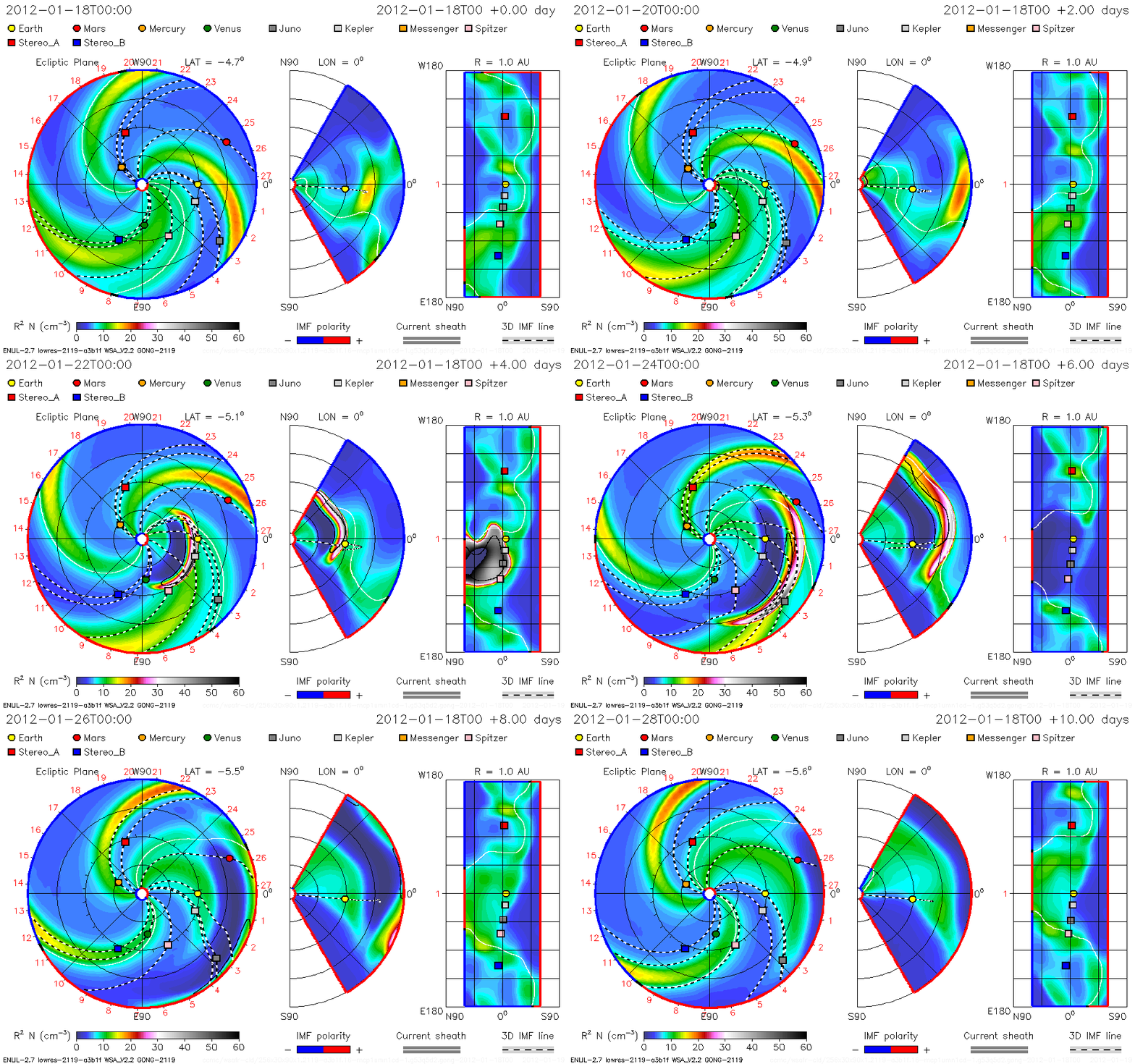
Here is a neat animation of the forecast, showing not only the Earth, but Mars, Mercury and Venus as well as a few spacecraft in orbit. The cloud is expected to hit here on Saturday, around 22:30 UT (plus or minus 7 hours). (The Space Weather Prediction Center has forecast that it will hit at high northern latitudes around 1:00 p.m. EST on Sunday, with the bulk of the disturbance on Monday.) Initially there were apparently fears that this would be a direct blast that could seriously threaten communications and satellites, but the Post reports that it is more likely going to be a glancing blow affecting high latitudes. It will reach Mars on January 24th.

We are heading toward a sunspot maximum in 2013, and sunspot activity and flares like this may increase. Another consequence of increasing sunspot activity is that the UV radiation levels increase from the sunspots. This activity "puffs up" the earth's atmosphere which puts drag on low-altitude space debris, causing it to slow down and eventually fall out of orbit.  Space debris has become a major concern for safety of the astronauts in orbit, and getting rid of some of it in this way is a good thing. I hadn't been aware, but in 2007 the Chinese "killed" one of their weather satellites in a test, creating over 3,000 pieces of debris bigger than golf-ball size. Only 6% of this debris has re-entered the earth's atmosphere.  There was also a collision of Cosmos 2251 and Iridium 33 satellites that created debris.

Could be some good aurora somewhere!

Here's more on CME's and sunspots from earlier posts: (1) The 1859 Solar Superstorm; (2) Solar Activity (and Newt Gingrich)--well, that's relevant today since it's the South Carolina Republican primary vote!!)

Friday, January 20, 2012

Great visualization of the Costa Concordia situation

Here's a nice graphic of the situation with the Costa Concordia:

http://news.sky.com/home/interactive-graphics/costa-concordia

Wednesday, January 18, 2012

Of sailing ships: Froude numbers

HMS Dreadnought
U.S. Naval History & Heritage Command photo
As an island nation, England has had a long tradition of strong navy ships, but ship casualties at sea were high, not just because of battle and pirates, but because of poor design. The Victorian Age was also the age of the ironclads--massive heavy ships.  One such ship was the "Captain", which turned turtle in 1871 with the loss of almost 500 lives.

A father-son team, William and Robert Froude had been working on ship design and had been conducting experiments with small ships on the River Dart, and later had built their own testing tank at Chelston Cross.**  When the Captain turned turtle, Froude gained support (an enormous sum of 2000 pounds!!) to cover the cost of building a tank in which he could test scale models of ships. This was to revolutionize ship-building, a practice that until then had been done by simple reliance on the experience of shipwrights.

William Froude died in 1879 at the age of 69, and a few years later the original experimental tank (called the Torquay tank) became obsolete.  Robert Froude built a new tank, 475 feet long, 20 feet wide, and 9 feet deep at Haslar. By 1918, over 500 warship models had been tested there, including the "Dreadnought," a revolutionary battleship that rammed and sank the U-29 German submarine during World War I.

Froude was concerned with reducing the drag on ships, and with the problem of applying results obtained from his models to the enormous battleships. There are two sources of drag on ships: viscous resistance from water on the hull, and wave-making resistance, the energy dissipated forming the waves that follow ships (the characteristic V-shaped wake behind ships). At high-speed the wave-making resistance accounts for 50-60% of the resistance.  The drag increased with the speed of the ship, and decreased for larger and larger ships.  A dimensionless parameter, now known as the Froude number, expressed this relation:

Fr = v/((gL)**0.5)

At low Froude numbers (low velocity and/or big long ship) viscous resistance dominates. At Fr=0.4 to 0.5, wave resistance dominates. Most conventional ships operate at Fr<0.4.


**Here's the reference on the two Froudes.
Here's a source of some of the other information that I used here.